

By far, the most interesting and entertaining character on What We Do in the Shadows must be Colin Robinson, portrayed by Mark Proksch. Unlike the bloodsuckers with which he shares a Staten Island abode, Colin sustains himself by draining others of life energy, not blood. Not traditionally immortal, energy vampires like Colin die then “regenerate” every 100 years, a unique reproductive method, even among cryptids. I mean, the offspring essentially is the same person, a strange cloning analog most assuredly. Colin possesses other supernatural powers. He can transform into a gecko, levitate, and throughout his century-long lifespan (lifespans?) he remains ageless. Of course, the more psychic energy he consumes the stronger he becomes.
Energy vampires have extraordinary manipulation skills. They engage in windy monologues, trite humor, and other maddening behaviors all pointed toward driving their victims into extreme states of boredom or annoyance, creating the energy they can draw into themselves for sustenance. We’ve witnessed Colin directing this feeding activity toward the show’s traditional vampires, at times making him a less than ideal housemate.
Energy vampires aren’t a concept created for What We Do in the Shadows. Like the traditional vampires with which he rooms, Colin’s type populates folklore and literature. The vampires from Nancy Collins’s Sonja Blue series, for example, feed off their victims’ fear while draining blood. Then there are the alien psychic vampires from Colin Wilson’s The Space Vampires, the inspiration for the film Lifeforce (1985). Most strikingly, however, Colin Robinson’s ilk has bases in real life.
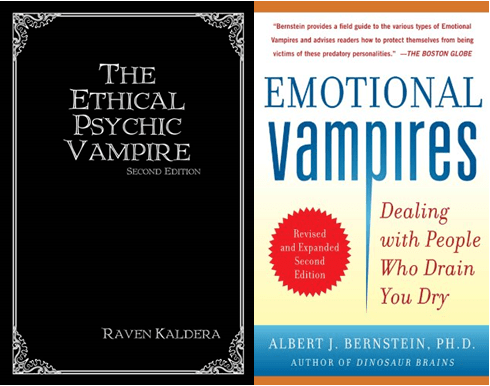
Links related to two books immediately appeared when I entered “psychic vampire” into a search engine. The first, Raven Kaldera’s The Ethical Psychic Vampire, 2nd Edition deals with actual energy vampires that walk among us here in mundane reality. There are two kinds of psychic vampires. The first are primary vampires, individuals born without the conversion circuits humans require to change outside energy into psychic fare. Secondary vampirism, then, is learned behavior picked up though illness, trauma, addictions, or other occurrences that drive energies low. Kaldera, a psychic vampire himself, explains that such vampires aren’t supernatural. Instead, they lack the “digestive” mechanisms that allow humans to process life force, or “prana,” received from the world around us. This energy flows from trees, rocks, other humans, all of nature, like water or electricity:
As you take in the prana from the whatever, your psychic circuits alter and transform it into something you can use (human-flavored energy) just as your digestive system breaks down and converts food into something you can use. Now imagine that you were born without a GI tract. In order to be nourished, you’d have to have your nutrients mainlined into your veins. You couldn’t do this yourself, especially as a child; your feeding would be dependent on others for the rest of your life.
And so psychic vampires must gather energies from others employing special methods to “feed.” Kaldera points out that certain “flavors” are more desirable than others. Anger, boredom, annoyance, and other such emotions are what he terms filet mignon. So, yes, like Colin Robinson these folks often work to generate these moods for enhanced dining pleasure, but ethical vampires abstain from agitating others for selfish gain, and Kaldera spends many pages outlining proper ethics for those living with this condition. Unsurprisingly, psychic vampires may be sanguinary, taking energy from others through the blood, but Kaldera stresses consent and safe practices throughout.

Kaldera’s not alone in believing that this phenomenon is real. Communities abound nationwide, the most famous being House Kheperu. Interested souls can find many others on Meetup.com, or they can read further by picking up Michelle Belanger’s Vampire Codex, which many consider the central text on the subject. Because, you know what? You can be a psychic vampire and not even realize it.
To say I was skeptical while reading about the above is an understatement. But the second book to appear in my searches has become legendary over the past decade or so, and it’s grounded in behavioral science, albeit for mass audiences. Albert J. Bernstein asserts that vampires don’t rise from coffins and roam through the night. They’re in fact your neighbors, co-workers, and they might even be “on your softball team.” In his book — Emotional Vampires: Dealing with People Who Drain You Dry, 2nd Edition – Bernstein outlines several different sorts who don’t rise to the level of formal diagnoses for personality disorders but still elicit behaviors that antagonize, abuse, exploit, and outright drain those who encounter them.
Fans of What We Do in the Shadows have experienced the emotional vampires Bernstein describes, and this is where the genius of the show’s creators shine. Viewers can identify people in their lives that act like Colin Robinson, who leave them so drained after encounters they can barely think or move. Hell, sometimes many – yes, including me – could have been Colin Robinson on occasion. Colin’s inclusion into that small Staten Island clutch moves the show beyond satirizing mythical vampire tropes into satirizing those real-life entities who inflict psychological damage, who suck us dry in so many low-key or outrightly manipulative ways. We’re laughing through our pain, and I for one approve heartily.
Bernstein advises readers how to defend against anti-social, histrionic, narcissistic, obsessive compulsive, and paranoid types. Colin Robinson doesn’t fit into any of these categories, but no worries since Bernstein’s characterizations are overly rigid and at junctures unkind. Nonetheless, I want to give his housemates Emotional Vampires, so they learn how to push back when Colin invades their boundaries during feeding times. Consider this garlic soup for the soul . . . metaphorically?
However one approaches psychic vampires, Colin’s earned quite a fanbase. I can’t wait to see what develops for his character next. His “rebirth” arc over the fourth season constitutes arguably the funniest moments I’ve witnessed while watching sitcom television. Colin may have come with the house when the other occupants moved in, but he’s welcome to stay both there and within our hearts. Just don’t be afraid to interrupt when those one-man verbal escapades enter a second hour.
 I WILL FIND THE RIGHT WORDS