
Everything is right with escapism. I know because I read comics. Instances from favorite stories took me away from terrible days at work or school. I was there for it when Galactus throttled the High Evolutionary, or, even more spectacularly, the Sphinx. When Captain America defied the Superhuman Registration Act and went underground — imagine being the Sentinel of Liberty and possessing that steady moral core. Finally, when at the end of Kingdom Come #1 Superman returns from his lengthy mourning to handle out-of-control super-beings I felt open wonder thanks to Mark Waid and Alex Ross. There are so many I could recount.
Brave souls, however, have been moving beyond escapism and asking deep questions about comics. Studies abound regarding the history of creators, characters, and the industry in general. Critics are asking questions about how comics speak to society, and how society communicates back to comics. Philosophy, theology, sociology, and psychology have all become lenses for analyzing graphic novels, and comic studies as a field keeps expanding at a rate impossible to pace. For examples of what I mean, check out my observations about studies related to Superman here. I treat Batman similarly here. I review books about Wonder Woman here. Then I briefly examine Captain America scholarship here. And I look at a Lois Lane biography here.
Mind you, I’m not nearly as academically erudite as others, and that’s especially true when speaking about those who have turned their energies toward Spider-Man. I’m reviewing three books, collections of essays that examine our favorite wallcrawler philosophically, psychologically, and theologically. With each, I’ll focus on articles that struck me deeply, that drove me to read more expansively about the topics presented because other than providing entertainment that’s what good reading does – it inspires you to read more, to feed the old noggin. Let’s belly up to the table, shall we?
Spider-Man and Philosophy: The Web of Inquiry by Jonathan J. Sanford (Editor) and William Irwin (Series Editor)
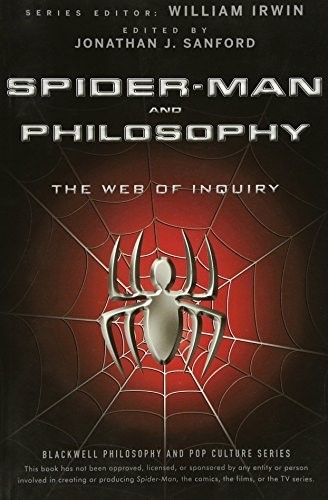
Spider-Man and Philosophy is part of the Blackwell Philosophy and Pop Culture Series. To my awareness, there are two such series, this one and Carus Book’s Popular Culture and Philosophy under its Open Court imprint, which has become Pop Culture and Philosophy under its Open Universe imprint. Blackwell and Carus follow the same goal: to present weighty subjects to general readers through attractive popular media. Mary Poppins was right. A spoonful of sugar does help the medicine go down. To date, there are volumes dedicated to Seinfeld, The Good Place, Neil Gaiman, David Bowie, The Godfather, and of course, superheroes both generally and specifically.
With Spider-Man, questions revolve around the meaning of responsibility, since Uncle Ben taught us, “With great power comes great responsibility.” Unsurprisingly, deontology enters the picture along with moral imperatives and other ethical considerations. Also included are explications of humor — since Spidey is the quip master — and narratology. Overall, it’s not a bad batch. A typo in the first article had me wondering who J. Jonas is, but, yes, it’s J. Jonah Jameson and not some forgotten Jonas brother.
What caught my attention is the section “Arachnids ‘R’ Us: Arachnids and the Human, All Too Human” which contains chapters on transhumanism and cloning. Jason Southworth and John Timm splendidly point out flaws within The Clone Saga while educating dunces like me about the truth surrounding cloning. Much handwaving occurs there, but what would comic books be without a bit of manually generated wind?
Ron Novy’s “Transhumanism: Or Is It Right to Make a Spider-Man” started my cerebral wheels spinning, however. Oxford tells us transhumanism means, “the belief or theory that the human race can evolve beyond its current physical and mental limitations, especially by means of science and technology.” Whether by accident or design, most superheroes are examples of transhumanist possibility. Steve Rogers transformed into Captain America through some fancy laboratory manipulation. Tony Stark not only employs technology to augment himself with his Iron Man armor but at one juncture modifies his body with extremis technology to enhance his techno-abilities. And Peter Parker was bitten by a radioactive (or genetically altered) spider and thus gained all those wallcrawling skills that make him the envy of Queens. Transhumanism – all of it.
Novy illustrates how he views transhumanism using Aunt May:
Aunt May is a cyborg. Her visual acuity far exceeds that of any member of her bridge club. Her access to stored information is incalculably greater than that of her ancestors. Her body’s metabolism is alterable more or less at will. All of this fantastical manipulation of her otherwise normal human body – yet it’s just another Sunday morning for Aunt May, sipping coffee and peering through her bifocals at the Daily Bugle. (145)
Wow. Following this reasoning, I too am a cyborg since I wear bifocals. I don’t drink coffee or tea, but friends joke about that “first cup” and the perks of caffeinated stimulation. We’re all more apt to digest our news through the Internet now, not an old-fashioned print edition like the one Aunt May enjoys. Hip replacement? Transhumanism. Metal pins in your ankle? Transhumanism. My daily hypertension meds and vitamins? Congratulations, Chuck! Colonel Steve Austin would be proud. Obviously, Novy proposes a wide definition of transhumanism, but even I know enough about it to realize the controversies involved. What are the limits our species is willing to accept with this topic?
Novy the transhumanist spends pages refuting Francis Fukuyama, who in his “The World’s Most Dangerous Idea: Transhumanism” (2004) criticizes the concept heavily. I’m no fan of Francis Fukuyama regardless of any stance he takes on any subject, but that’s neither here nor there. Before confronting Fukuyama, Novy outlines basic criticisms of transhumanism:
Among the many criticisms of deliberate enhancement beyond the mere human range, three related themes stand out: that enhancement requires one to play God with the natural order; that it will destroy the equality of persons that underpins liberal democracy; and that it deprives the enhanced being of his or her pure human essence. (146-147)
When disputing Fukuyama, he states:
So, in response to Fukuyama calling transhumanism a “strange liberation movement,” we might say, “Yes, it is, and a good thing too.” The ongoing effort to free ourselves from the biological inheritance of our ancestors is a defining characteristic of human history – from the first pointy stick to the latest antibiotics. According to Fukuyama, the effort to wrestle “biological from evolution’s blind process of random variation and adaptation and move to the next stage as a species is to be feared and avoided.” On the contrary, given the trajectory of human technology and medicine, it not only seems inevitable that we will continue to push against whatever limits our abilities, thoughts, emotions, and duration exist, but we actually have a responsibility to do so. We may never be quite like a “god among men” as Glaucon expressed it, but nonetheless, humans have continually met and broadened those limits to good effect. (151-152)
The word avoided here is ableism. Transhumanism whether you support it, is inherently ableist. Novy and Fukuyama, at least presented through Novy, leave this out of the equation. Novy’s right. Science and technology will continue advancing human survival. While living in Ukraine, I was discussing my cancer history with a doctor who informed me that if I’d developed cancer there and not in the United States, I’d be dead. Yes, but this speaks to survival. I survived. Others might make choices when facing chronic pain or to enhance their quality of life, not to be the next Hugo Danner (eugenics – egad). In a paper appearing in The Varsity entitled “Can We Evolve on Our Own Terms?,” Whitney Buluma says it much better than I can:
It can be argued that transhumanism is simply arguing for a more extensive use of such assistive devices. However, the rhetoric of transhumanists is implicitly an ableist one. It assumes that people with disabilities are in need of “fixing,” and that their lives would be improved by giving them the same abilities as abled people.
Properly working elevators and accessible buildings are far more within our reach than bionic implants for improving the quality of life — environmental changes are viable. I’m not poo-pooing my bifocals or anyone else’s hip replacements, but ramps, please. Besides, I choose bifocals over Lasik surgery. They work for me.
Spider-Man and Philosophy passes my inspired-to-read-more test. I surely have more to read on ableism and probably said something above that’s not quite accurate. I’m more waking up than woke, I’m afraid. Hopefully, something inside this volume likewise will inspire you.
Spider-Man Psychology: Untangling Webs by Travis Langley (Editor) and Alex Langley (Co-Editor)

Travis Langley’s made quite an industry by applying psychological concepts to comics and other pop-culture phenomena. A Professor of Psychology at Henderson State University who once investigated child-abuse cases and boasts of a Wheel of Fortune championship, he’s edited collections analyzing Batman (now in its second edition), Wonder Woman, Daredevil, the Black Panther, Captain America and Iron Man, the Joker, Star Wars, The Walking Dead, Stranger Things, Doctor Who, and Supernatural. Now we have Spider-Man Psychology. The self-identified “superherologist” has covered it all.
We receive a wider consideration of the Spider-Verse, particularly Miles Morales, but Miles had been around maybe a year when Spider-Man and Philosophy was published. Spider-Woman, Ghost-Spider, and others garner no notice. Perhaps sequels entitled The Spider-Verse and Philosophy and Spider-Verse Psychology will appear someday? There was enough with Langley and Company to spur inner dialogues, nonetheless.
Joe Deckelmeier from Screen Rant talked with Langley, and the psychologist revealed why he thought Spider-Man has kept his popularity through the decades:
It is his humanity that makes him popular, what makes him endure. That neurotic quality appeals to us because, to one degree or another, we’ve all got something neurotic in us, which means it’s normal to have something neurotic in you, to a degree. It’s a lot of work and a lot of fun going in all these. This one, I loved working on it so much that if I never did another one, I said I felt like it would be complete to me.
This rings true not only for Peter Parker but for Miles Morales as well. Miles originated in Marvel’s Ultimate Universe, but his popularity inspired creators to continue with him when that venture eventually waned. But their “neuroses” are different, and so fans relate to them for different reasons. Richard-Michael Calzada and Vanessa Hintz explain how this plays out in their “From a Leap to a Spark: Mile Morales and the Coming-of-Age Experience for Latinx and Black Heroes,” where they define social ecological theory as being raised in a “complex system involving family values, cultural norms, laws, and superhero ideologies. (52)” Peter too came of age in a complex environment, but he’s White, not biracial Black and Latinx like Miles. The authors explicate why this variance matters:
Young Latinx males often undergo institutional violence and mistreatment from authority figures, such as teachers, school resource officers, and rival members of different peer groups, including gangs. Thus, Miles stays aware of how people perceive him. As the son of a police officer and a nurse, he shows standards of model teen behavior higher than those of the average student. His vigilance is a way of not only keeping himself accountable but also surviving a harsh world. (52)
Other than the villains his Spidey persona confronts, Peter deals with Flash Thompson and J. Jonah Jameson, but his teachers love him, gangs don’t enter his world, but not so with Miles. What’s important for Miles is “critical mentoring,” a mentor relationship that is culturally aware, and that understands Latinx and Black experiences.
Essentially, Miles himself mentors young fans of color. For decades, my generation and those that followed benefited from Peter’s existential adventures, but the Spider-Verse has enhanced these chances for many.
In “Finding Your Inner Superhero: Adolescent Moral Identity Development,” Apryl Alexander offers her views about this topic, identifying how Miles seeks individuation, a sense of his own self:
In fandom, some debate surrounds the notion of racebending characters (i.e., taking established characters and changing their race). When the mask Miles wears gets damaged and partially exposes his face, a reporter notes his apparent race, which is not how Miles wants to be defined. In essence, he wants to be known for his actions and commitments to community rather than his racial/ethnic identity . . . Miles just wants to be Spider-Man. (66)
Alexander is mindful of colorblindness, however, and cites W. E. B. DuBois and his “double-consciousness,” how Black people “often balance integrating their sense of self and Black identity with the need to placate to whiteness and the White gaze. (66)” She advocates for Miles’s heritage just as strongly as Calzada and Hintz.
I quote heavily above to give you an image of how Spider-Man Psychology operates. Psychological professionals outline terms, bring issues, and apply them to all things Spider-Man. Mentorship and coming-of-age are only two pieces from an extra-large combination pizza. Contributors provide insights covering relationships, post-traumatic stress, and even Jungian analysis. Key terms are italicized, and relevance permeates the text. Anything by Langley is worth the price of admission. My reading lists experience substantial growth each time I encounter his collections.
Theology and Spider-Man by George Tsakiridis (Editor)
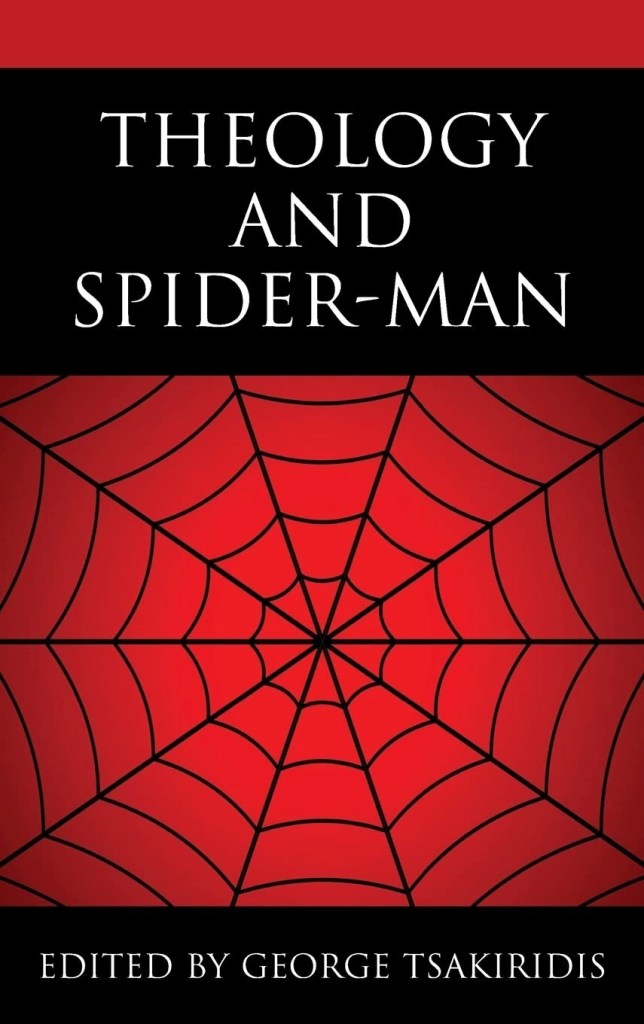
Senior Lecturer of Religion and Philosophy at South Dakota State University George Tsakiridis has gathered several theologians who’ve directed their analytical skills to Spider-Man. Upon discovering this book existed, I wasn’t sure how I felt about Theology and Spider-Man, since I’m not a churchgoer. Theology for me stands apart from religious studies or comparative religion, the latter two being more palatable to my reading tastes. Would these authors use Spider-Man as a symbol for born-again Christianity, that Evangelical sort who have wedded themselves with the rampaging totalitarian Republican party? Thankfully, no. I found Theology and Spider-Man the best out of the three volumes I’m presenting, even if the cover price for this academic offering stands at a staggering $111.00 full price for hardcover and $45.00 for Kindle! My employee retention bonus from the County of Santa Clara helped ease the strain, most assuredly.
During an interview with Populartheologyandculture.com, Tsakiridis reveals why he pairs Spider-Man and theology:
The core of intellectual curiosity into Spider-Man is fairly evident. He is a deeply moral figure who has suffered loss. He lives by the somewhat biblical phrase, “with great power comes great responsibility.” Spidey also raises a lot of curiosity in his scientific and genetic makeup. He is transformed into a being with two natures, both spider and man, and his title “Spider-Man” is reminiscent of the early Christian creeds describing the “God-man.” His very nature also raises bioethical questions, as do his foes. Many of them arise out of the misappropriation of scientific knowledge, Lizard and Dr. Octopus foremost among them.
And he describes what’s between the covers:
In this volume, the essays start with the foundational questions of sin and salvation, but move into broader theological discussion of creedal belief, bioethics, and iconography. Engagement with Black Theology and Liberation Theology are explored. The volume presents a kind of constructive or quasi-systematic theology of Spider-Man. But it just starts the conversation. Given the diversity of sources: films, comic books, toys, video games, etc., all of which are explored in the volume, one cannot create something comprehensive in 250 pages. What a volume like this can do is create inquiry, wonder, and narrative for your own engagement with Spider-Man. I encourage you to read this volume with an eye to fun and creativity, undergirded by moral and theological depth, and I think you’ll find joy in the journey. Of course, as the editor I’m fairly biased.
Theology and Spider-Man upped my additional reading game, especially concerning liberation theology, a concept I’d encountered before through Gustavo Gutiérrez, a Peruvian philosopher and Dominican priest. Centered in Latin America, liberation theology rose first during the twentieth century and practitioners direct energies toward the poor and oppressed among us. Marxist thought enters the mix, blending with Catholic practice, highlighting a reconstruction that drives focus toward relations between oppressors and the oppressed. These precepts have been applied to other marginalized sectors, including women and LGBTIA+, by Marcella Althaus-Reid and others, and race by a name that bursts with importance within one article that caught my attention – James Cone.
Matthew Vega and Russell P. Johnson direct James Cone’s thoughts at Miles Morales. They examine Peter Parker’s identity growth throughout the Sam Raimi films and also Miles’s throughout Into the Spider-Verse. Miles undergoes a different journey than Peter’s, of course:
In the first act, Miles is caught between two realms: one in which he belongs, and one which is alienating. These two worlds are racially coded. As he walks past his old exchange trash talk, and he does a special handshake with a friend. The scene outside Brooklyn Middle School is in stark contrast to Miles’s new private school, Visions Academy. In this school – racially diverse, but primarily white – Miles’s jokes fall flat, and he has trouble making friends. One student says, “Your shoes are untied,” and doesn’t stick around to hear Miles, exasperatedly, explain that this is intentional. (136)
Miles strives to blend these two worlds in much the way James Cone, a Black theologian active beginning in the 1960s, blended theology and Black Power, moving away from his former stance where he kept silent about Black Power issues because he wanted to show White people that “he was a good Christian Negro with good manners.” (140) Both Miles and Cone eventually remove masks that don’t fit them, choosing instead raiment or attitudes that serve and enhance their authenticity. Although he’s not the only Spider-Man, he becomes his own Spider-Man whereas Cone becomes his own authentic theologian serving an oppressed population. I very much want to read James Cone now.
Another article treats liberation theology with a stunning example. Josh McDonald gives us “Venom, the Liberation Theologian.” Yes, that Venom. When first seeing that title, I thought, “Oh, I’ve got to see this.” How could a villain even symbolically represent philosophies with goals of reformation, reconstruction, and renewal? After reading McDonald, I exclaimed, “Yes, that works!” I was only vaguely aware that Venom had shifted from villain to antihero. I must catch up, it seems.
McDonald posits that liberation theologists mind not only the materially poor but also innocents. Venom apparently protects the poor and the innocent, and McDonald tells us more about that:
Venom knows that “to be oppressed is to be against the oppressor . . . to run personal risks – even to put one’s life in danger. Compare Venom’s approach to the poor and needy with Spider-Man’s. Venom is very careful to put the homeless and downtrodden at ease. He hides his Symbiote and even undertakes the effort to make his living costume blend in with that community. He apologizes for exposing them to the bloodiness of his justice. He passionately defends them and works to cleanse their neighborhoods. On the other hand, when confronted with the struggles of real people living in bad neighborhoods, Spider-Man takes them to the top of the city to admire the lights and to inspire them with tales of the city’s potential. Both are cases of pastoral care, of course, but Spidey’s seems effete in comparison. (181)
Mind-blowing, right? So, why does liberation theology grab my attention rather than other interesting titles – “Tyger, Lamb, Spider, Hunter: Kraven’s Last Hunt and the Web of Theodicy,” or “Untangling the Web of Sins: the Superior Spider-Man as Secular Hagiography,” or “Spider-Man: An Icon in Your Pocket,” for example? Liberation theology speaks not only to Catholics but to Protestants. Much Christian practice has drifted too far from where liberation theology hopes to return it. I’ll never be a church-goer, but I’ll feel relieved when far-right, demagogic hate centers many call “churches” move into the minority behind those centers I know are practicing truly good works among oppressed individuals. Liberation theology shows us how maybe even partly because of the Marxist theories considered.
I hope you take away much from these books. Obviously, I have. I’m looking now toward the stack delivered just this afternoon, most of which came because I read these three books. These books made me care enough to explore more. What more of an endorsement could anyone want?
 I WILL FIND THE RIGHT WORDS