
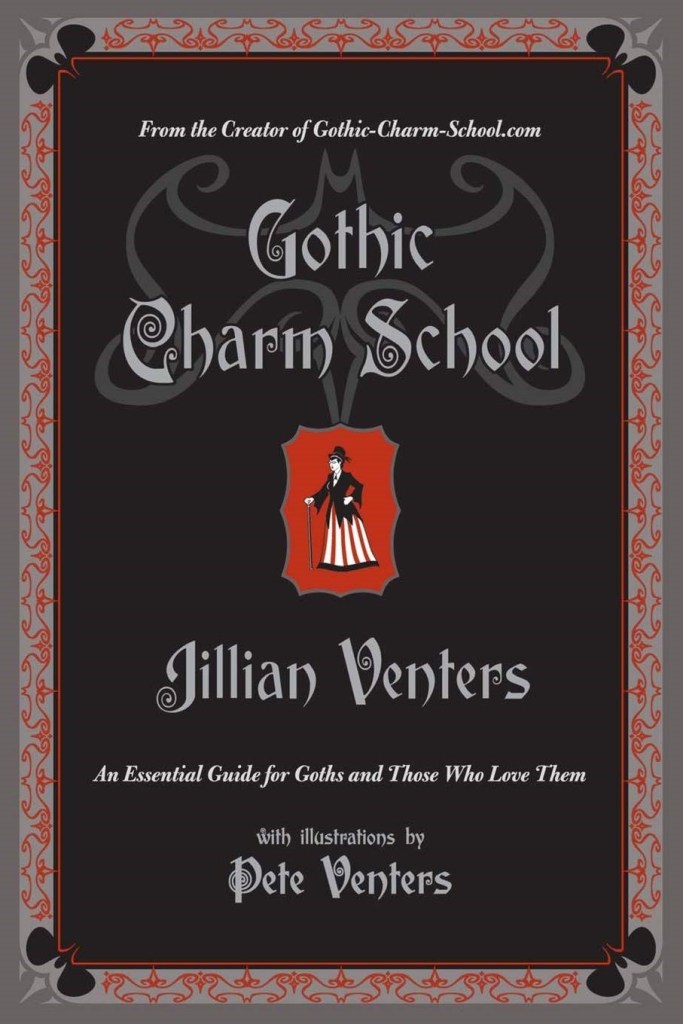
For decades, Jillian Venters, the Lady of the Manners, has been cultivating better deportment among goths, which is important because individuals should resist reacting to harsh societal judgments about this subculture with equal venom and thus inviting perhaps even worse abuse. There are additional perks as well:
There’s an added benefit to being a Goth and having good manners: it’s actually more shocking to some people than the “Booooo! I’m so spooky and scary!” antics they expect from Goths. Looking like you’ve just come from a gathering with a particularly sinister dress code and being gracious and polite messes with some people’s heads far more effectively than anything else you might be able to think up. (2)
Nonetheless, Venters is more interested in keeping things civil than providing fodder for head games. She wants us all to play nicely together. Not only does she instruct her goth cohorts, but she also enlightens non-goths about their shadowy loved ones, challenging stereotypes and fears surrounding the lifestyle. It’s even in the book’s subtitle.
During the early 1990s, I frequently walked after hours, clearing my head and enjoying Campbell, California without bustling noise and other daytime distractions. Often I encountered a group of teens, sporting capes and heavy eyeliner, sometimes reading passages from Poe, Rice, Lovecraft, Brite, Machen, Chambers, or others beneath parking garage lights, each taking turns within the circle they’d formed and enunciating the words like acolytes summoning Mammon or Azazel. At other times, I witnessed them running through parks or congregating near load docks while LARPing Vampire: The Masquerade adventures. This is Venters’s target audience, and she’s well qualified to educate such baby bats.
Expanding from her website, www. gothic-charm-school.com, Venters covers everything from goth weddings to helping those outside the subculture dress and act when visiting goth settings or events to avoid drawing unwanted attention or insulting their hosts. Most educational is the section, “Gothy Cliché s and Why They’re So Pervasive.” Here outsiders receive excellent lessons about how goth works that hopefully will move them beyond erroneous preconceptions. Take this to heart: Friends don’t let friends dress like the Crow. Many consider The Crow a hallmark goth film, but it’s entered the mainstream, inspiring many beginners and wannabes to emulate Brandon Lee’s iconic look. Venters defends her admonition:
Dressing up like the Crow is considered by most Goths to be trite, overdone, and a bit like holding up a sign that says “mostly clueless.” But you know what? The Lady of the Manners also thinks that if you really, really, really want to dress up like the Crow, you should do it. If that is what makes you happy, if you think that would be the coolest Halloween ever for you, then do it. The Lady of the Manners does, however, have two pieces of advice. First: accept that people will roll their eyes, snicker, laugh, and generally try to make you feel like an idiot. Ignore them. Second: Do the best job you can with the makeup and assembling the costume. (98)
She continues by warning those without the “proper physique” to avoid Crow costumes, since “it is a sad, harsh fact that nothing becomes an object of ridicule faster than a heavier-set person dressed up as a character previously portrayed by Brandon Lee” (98). Venters strives to protect others from emotional harm, of course, but nothing becomes an object of wrath faster than a body-shaming asshole among those following Venters’s larger message about civility, kindness, and tolerance. Good manners include supporting anyone engaging in harmless self-expression. Remember to judge not, keep your stones from glasshouses, and know that the author of this review and others supporting codes of conduct at public events have your back.
Begin with Venters if you have no experience with goth. She provides a nicely written entry-level study chock full of advice that applies not only to goths but to humanity at large. Much of how goths should treat one another is how we all should treat one another. You’ll enjoy the illustrations by her husband Pete too. I thought the author’s constant referring to herself in the third person would put me off, but she handles that nicely from the outset, admitting that this is an affectation utilized for frivolous fun. Recently, I quipped online that I’ve never encountered a mean goth girl. Venters vindicates that observation admirably.
 I WILL FIND THE RIGHT WORDS