
As a suicide-prevention and crisis-intervention counselor, I understand that individual experiences often don’t pair well with what professional texts explain about conditions as they apply to groups. Professional texts have helped me to understand schizophrenia, bipolar disorder, suicidal ideation, and personality disorders, but how are these situations reflected by the individuals living with them?
So, when studying psychological subjects, I combine professional texts with autobiographies and non-fiction from those living in such realities. Recently, I did so while exploring neurodiversity. I acquired professional texts such as Jill Boucher’s Autism Spectrum Disorders: Characteristics, Causes, and Practical Issues, Third Edition; Editor Damian Milton’s The Neurodiversity Reader: Exploring Concepts, Lived Experience, and Implications for Practice; Unmasking Autism: Discovering the New Faces of Neurodiversity by Devon Price, and finally Neurotribes: The Legacy of Autism and the Future of Neurodiversity by Steve Silberman.
You know what? If you scan those titles closely, you see that all but one considers “lived experience.” Indeed, the authors above are either neurodivergent or have their lives impacted by it. Lived experience stems from personal experiences, but it also addresses how people apply their hard-knock expertise when helping others, many times becoming professionals. It’s awesome that the above authors have approached things this way, but I still sought out non-professional autobiographies and books by writers from the neurodivergent population. Two from my list highlight current trends within the Neurodiversity Movement and efforts toward moving past medical models much more than professional texts.
But Everyone Feels This Way: How An Autism Diagnosis Saved My Life by Paige Layle
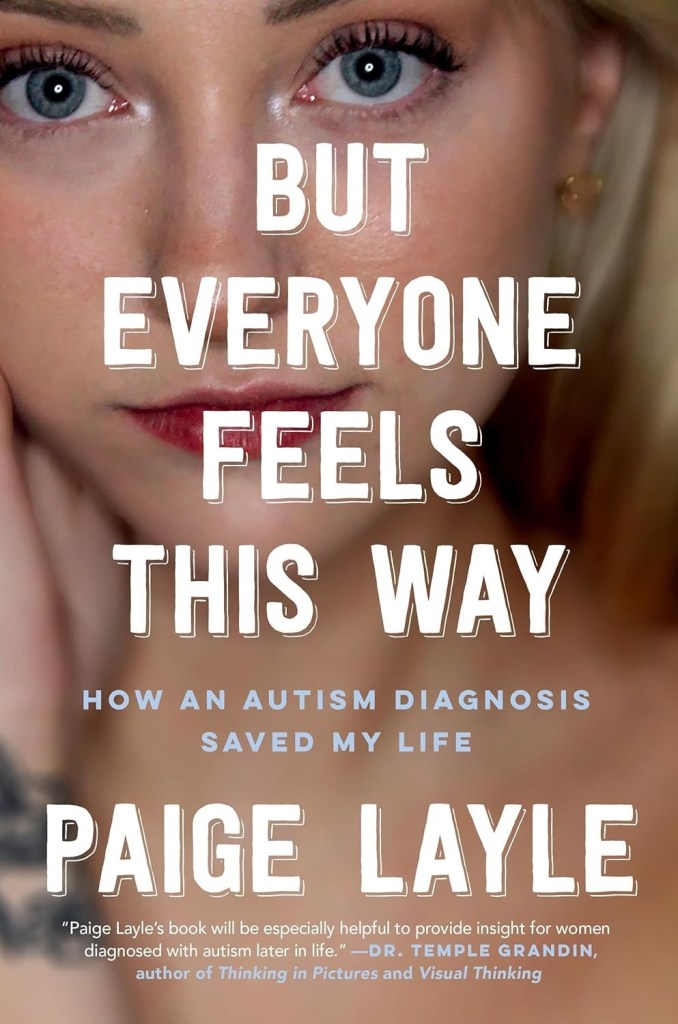
Paige Layle has been advocating for autism awareness through TikTok, educating the public about life as an autistic AFAB person. This book, then, extends from those posts, moving readers through their lives, relating how, like so many, they masked behaviors hoping to appear “normal” among peers. After years of meltdowns, a suicide attempt, and endless psychological pain, Layle was diagnosed with autism spectrum disorder at age 15. Did rainbows suddenly flair across the sky? Of course not, but at least they had a framework for understanding life and relationships with others.
Mostly, Layle relates their background, which is not a bad approach for an autobiography, of course. However, controversy arose from certain stances they take on autism. For example: “I’ve heard people use the phrases ‘high support needs’ and ‘low support needs,’ but I think the way they’re used is pretty much the same as the functioning labels. And I think they are still way too vague to be able to provide any real, actual support.” This shook members of the neurodivergent community who fear losing accessibility services.
Layle advocates strongly for breaking misogynistic stereotypes surrounding autism. Nonetheless, critics feel they veer into over-generalizations and don’t examine diversity far enough. Tistje posting on Medium.com states:
Layle’s narrative, deeply personal and reflective of her own experiences, sometimes strays into the realm of over-generalization. While her personal journey is undeniably valid, the extrapolation of her individual experiences to the broader autistic community can be problematic. Autism is a spectrum with a wide range of manifestations, and no single account can encapsulate the diversity within this community. By positioning her narrative as a somewhat universal autistic experience, Layle risks perpetuating misconceptions about what autism “looks like.”
In summary, Layle is an expert on autism based on her own experiences. Intersectionality matters—race, gender, sexuality, and class deserve further thought—so my reading habits are so expansive. I want as many different views on any subject as possible. Layle comes from one perspective, and leaving off your explorations here could limit the journey. Layle’s a good starting point, but follow many, not one.
We’re All Neurodiverse: How to Build a Neurodiversity-Affirming Future and Challenge Neuronormativity by Sonny Jane Wise

Australian neurodivergence activist Sonny Jane Wise moderates Lived Experience Educator, their website dedicated to raising awareness about neurodivergence. This book is not an autobiography but is rooted in learned experience and Wise’s advocacy work. Wise questions neuronormativity, patriarchy, white supremacy, and capitalism. Far more than Layle, Wise proposes actions and practices for improving lives intersectionally. While appearing on the Reimagining Therapy Podcast, Wise explained:
So who I am, I guess I would like to say that I’m a nonbinary and disabled and multiply neurodivergent advocate, and speaker, and writer. And what I’m putting out in the world is, I guess, a paradigm shift where we change how we view and understand neurodivergent people. So that’s what I’m putting out in the world.
The paradigm shift in question is toward the Neurodiversity Paradigm, an umbrella under which multiple conditions reside – schizophrenia, bipolar disorder, personality disorders, ADHD, dissociative disorders, autism spectrum disorders, and others. It’s about working with differences to enhance inclusivity and promote understanding of intersectionality, how gender, race, and other demographics affect how neurodivergence is perceived and discussed.
Arguably, Wise is the most effective advocate for neurodivergence since Temple Grandin, a pioneer of the Neurodiversity Movement whose personal successes in the cattle industry inspired not only others diagnosed with autism but the world overall. This Movement, like the Paradigm, strives toward turning away from medical models, from pathology and instead practicing accommodation. At the beginning of We’re All Neurodiverse, Wise speaks about her lived experience:
I was exposed to the psychiatric system and taught there was something wrong with me from an early age; the neurodiversity paradigm was the framework I had been looking for. When I learnt about neurodivergence, it was exactly what I needed to unpack and unlearn the years of shame and blame that the pathology paradigm taught me. It’s why I wrote this book; to give other people the opportunity to discover a new lens, to challenge the concept of disorder and begin to identify and decenter neuronormativity. When we decenter neuronormativity, we can actually accept the different ways people function.
“We can actually accept the different ways people function.” Let’s transform hope into reality.
 I WILL FIND THE RIGHT WORDS