
Motel Hell (1980)

Roger Ebert once dubbed Motel Hell “a welcome change of pace; it’s to The Texas Chainsaw Massacre as Airplane! is to Airport.” Ebert even admires certain scenes, including a chainsaw duel and the final confession from the dying Farmer Vincent, the proprietor of Motel Hello (the “o” on the sign has burnt out . . . I think you get it) and purveyor of fine smoked meats. For decades, people have traveled far and near to sample Farmer Vincent’s wares, and, of course, Vincent never reveals his secret recipe, only quipping that “Farmer Vincent’s fritters take all kinds of critters!” Critters? Look in the mirror. That’s you and me, readers, mixed with pork and spices. At least we taste better than Soylent Green.
Brothers Robert and Steven-Charles Jaffe wrote and produced this film, aiming to spoof the wave of sleazoid fare during the 1970s. The Jaffes primarily targeted Tobe Hooper to direct, but they went with Kevin Connor of From Beyond the Grave (1974) fame when his studio passed. Western icon Rory Calhoun stars as Farmer Vincent Smith, with Nancy Parsons (Beulah Balbricker from Porky’s) playing his sister, Ida. Ida’s quite the trapper, lining local roads with snares, causing accidents from which she can pull humans, drug them, disconnect their vocal cords, bury them up to their necks in a walled-off garden where they’ll be fed protein paste through funnels until fattened and ready for “processing,” finally breaking their necks by putting them in nooses and towing hard with a tractor. Amazingly, this worked well for many years, right under the nose of Vincent and Ida’s brother, the dimwitted Sheriff Bruce Smith (Paul Linke), who never catches on. Then enter Terry (Nina Axelrod) – lovely, blonde, and needy. Things unravel from there.
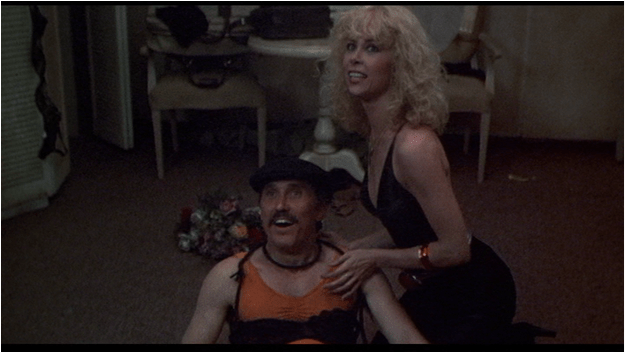
Viewers will enjoy visual and plot touches that enhance the film’s campiness. For example, Farmer Vincent sports a pig’s head when wielding his chainsaw. Why? Most likely, this references Leatherface’s habit of wearing masks made of human flesh while staying true to Motel Hell’s themes. My favorite touch, however, is Elaine Joyce, a perennial face on television screens throughout the 1960s and 1970s and a regular panelist for several game shows. Here she’s Edith Olson, one-half of a kink couple who responds to Farmer Vincent’s ads about Motel Hello catering to such activities, another trap! What the hell? Sweet, wholesome Elaine Joyce is wearing a revealing leather suit while cracking a whip. Is it better than Lash LaRue in his heyday? At the time, this was genius casting, given how it played with the audience’s collective mind. Back then, I rarely watched cable films without Cannabis, but I’ll admit to feeling weirdly and deeply attracted to someone essentially a TV mom. Who knew she had it in her?
Motel Hell remains a cult classic, even available on Blu-Ray. If Psycho didn’t make you anxious about rural hotels, Motel Hell will do the trick. I defy anyone from visiting Hickory Farms during the holidays without wondering if Vincent and Ida are working in the backroom. They proudly stand behind their products until Vincent’s confession, which I mentioned in the first paragraph. He uses preservatives. Gasp!
Dirty Mary, Crazy Larry (1974)

Car-chase films enjoyed much attention during the late 1960s and 1970s. Fans remember Steve McQueen’s Bullitt (1968) or Burt Reynold’s Smokey and the Bandit franchise, but not much goes toward Dirty Mary, Crazy Larry, a grittier take on the Bonnie and Clyde (1968) trope with much better cars. Race-car driver Larry Rayder (Peter Fonda) and his mechanic, Deke Sommers (Adam Roarke), devise a scheme for quick money to fuel their NASCAR dreams. While Deke holds a supermarket manager’s wife and daughter hostage at their home, Larry extorts cash from the manager at the store, running off with $150,000. Already, matters become complicated; however, because of the one-night stand Larry had the evening before, Mary Coombs (Susan George) forces him to take her along in his 1966 Chevrolet Impala, and off the trio go speeding toward a hopeful getaway. They’ll later ditch the Impala for a 1969 Dodge Charger R/T 440. You can never have too many muscle cars in chase films. The formula worked, with grosses equaling $650,709 during its opening weekend in Texas and Oklahoma.
Of course, there’s a sheriff in hot pursuit, Everett Franklin, played by Vic Morrow, cut from the same cloth as Jackie Gleason’s Buford T. Justice, although more serious, and Billy Mack from Steve Miller’s song, “Come On, Take the Money and Run.” Of all such films I’ve seen from this genre, Larry’s the meanest of them all. Mary, often clever, draws more sympathy, with unexpected overtones from a previous role, Amy Sumner from Straw Dogs (1971). John Hough, famous for The Legend of Hell House (1973), directed Dirty Mary, Crazy Larry. He describes the experience: “We had about 20 exciting stunts and about five minutes’ worth of acting. We had to make our scenes count. Adam Roarke, Susan George, and I were sort of like The Three Stooges; I guess you could say . . . I had a fine time making the film. It was a lot of fun.”
Despite Larry’s asshole demeanor, Dirty Mary, Crazy Larry is as fun to watch as it was for Hough to direct it. I remember seeing it at the original Campbell Twin, which spotlighted Amicus horror and low-budget action films, located in a strip mall with Dolphin Pet Store, D & J Hobby, and the Sav-On Drugstore, where we scored our candy before each visit, stashing it in my sister’s purse. We got away with it every time, unlike our doomed threesome, who didn’t reach the state line. To paraphrase Steve Miller, “They got the money, hey, they DIDN’T get away!” Fate and a touch of hubris intervene, not the massive police pursuit. Dirty Mary, Crazy Larry isn’t the best of the genre, which I’ll grant to Bullitt, featuring sharper cops. But it certainly isn’t horrible like Smokey and the Bandit. If Larry is an asshole, Bandit is just a douchebag. That Bandit gets away will bug me forever. I can’t let it go. I would have captured him outright.

Spring Break (1983)

Writing for The Downtown Review, Thyra Chaney, in her “Age of Exploitation, Teen Sex Comedies of the 1980s,” outlines how rising production costs and studio corporatization led to an uptick of “formulaic over-marketed genre films to audiences who became accustomed to flimsy plots and sensationalized set-pieces.” This meant financial triumph through risk-avoidant reliance on plot formulas, but it also meant limited creativity. Enter the teen sex comedy, an exploitative genre featuring horny teenagers, much beer drinking, and a distinctly male-centered gaze. National Lampoon’s Animal House (1978), Caddyshack (1980), Porky’s (1981), and Fast Times at Ridgemont High (1982) are paradigmatic of the type. Recent entries include American Pie (1999) and Superbad (2007). Alas, the Suck Fairy hasn’t been kind to many teen sex comedies, waving that wand handily and, for some, outright pummeling them into semi-oblivion.
You won’t find Spring Break ranking high on lists of teen sex comedies, favorite or otherwise. I could only find it on IMDb’s “Favorite Raunchy Comedies of the 80s,” compiled by Gareph J., where it ranked 32 out of 60. Even lists dedicated to spring-break movies failed to include Spring Break, which is impressive considering that the title is the sub-genre! Maybe the plot’s too simple? Two nerds, Nelson (David Knell) and Adam (Perry Lang), book a room at the Breeze and Seas, a dive hotel in Fort Lauderdale, Florida, hoping to party hard during their first spring break. However, the hotel was overbooked, and the two ended up rooming with Stu (Paul Land) and O.T. (Steve Bassett), cool guys from New York. What follows is a succession of one-night stands for Stu and O.T., much beer drinking, and wet T-shirt competitions. It is spring break, after all.
There are complications, however. Nelson hides from his stepfather, Ernest (Donald Symington), who is running for political office, and God forbids Nelson from ruining his stepdad’s chances by shirking his election duties. Ernest connects with Eddie (Richard B. Shull), the hotel owner’s brother-in-law. Eddie wants the hotel shut down so he can buy it cheap. Ernest will help if Eddie finds the wandering Nelson. This covers much territory trod upon by other films. Ernest resembles Judge Elihu Smails, Ted Knight’s corrupt character from Caddyshack. Studios were after repeating financial winners, remember, even if not winners artistically.
Why do I like Spring Break? The romance between Nelson and Susie (Jayne Modean) melts me always, even with all its mawkishness and tropes pandering to nerd boys everywhere. Our four heroes are out drinking and in a bar holding a wet T-shirt contest (what else?), and Nelson spots Susie playing Galaga. What male nerd of that era could resist such a set-up? Well, not me. She later takes him to her hotel, and once in her room, she asks him to fetch sodas from the lobby. Nelson forgets her room number, and after he frantically disturbs other guests while searching, hotel security throws him out. And Susie’s going home the next day! The next day, Nelson spots her participating in a bikini competition. Susie stayed to find him. Why a bikini competition? Did she think this was the best way to stand out for him if he happened to be in the audience? The writers never clarify this, and why should they? They only want more bikinis on camera. Nonetheless, I’m a fan of true love. Just call me a sucker.
Mad Magazine Presents Up the Academy (1980)

Mad Magazine taught me more about politics than my junior and senior high school social studies and civics courses combined, though I’d been reading it long before adolescence. Speaking about poetry, Sir Philip Sidney in The Defence of Poesy states:
This purifying of wit, this enriching of memorie, enabling of judgement, and enlarging of conceit, which commonly we call learning, under what name so ever it come forth, or to what immediate end soever it be directed, the end is, to lead and draw us to as high a perfection, as our degenerate soules made worse by their clay-lodgings, can be capable of.
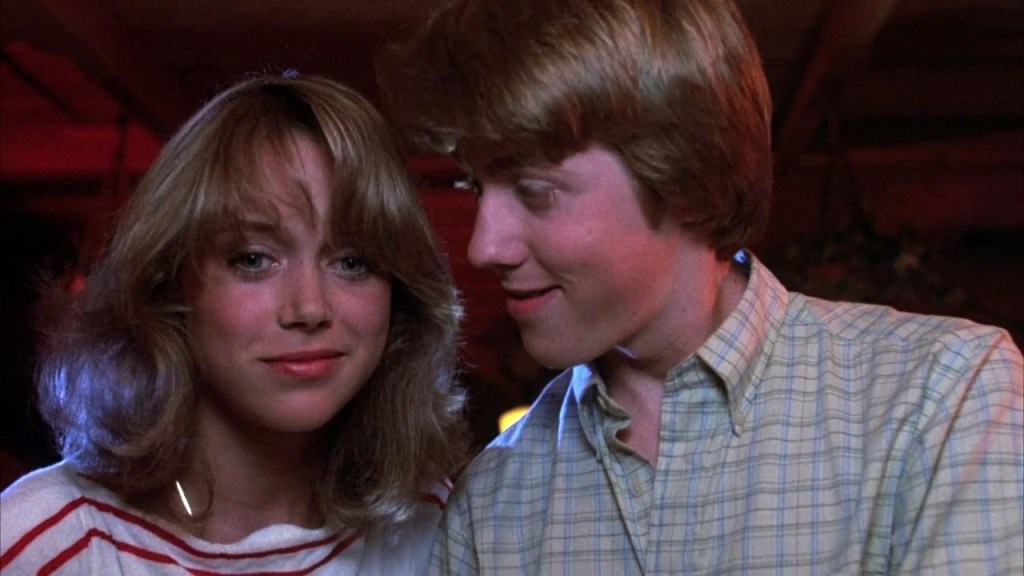
Mad Magazine did for me what poetry did for Sidney. When I didn’t understand references to Watergate, Vietnam, or Civil Rights, I either asked my parents or consulted encyclopedias. Entertainment enhances education, but then the Usual Gang of Idiots decided to make a movie, Mad Magazine Presents Up the Academy, about four outsiders attending Weinberg Military Academy for their sins.
Few diehards remember it, and for good reason. Mad’s publisher, William M. Gaines, hand-wrote apologies to each fan complaining about the stinker. Ron Liebman, who plays Major Vaughn Liceman, demanded his name be removed from all credits and promotional materials. Until Gaine’s death, all references to Mad Magazine were removed from home entertainment releases. Even Robert Downey Sr., the film’s director and father of Robert Downey Jr., called his effort “one of the worst fucking things in history.”
While rewatching it, I noticed especially the subplot involving young boy/older woman sexual relationships. The older hot woman represents the ultimate score for adolescent boys yearning to learn the ways of love as only an experienced partner can teach them, providing pure titillation for teen-boy audience members. Risky Business (1983), Class (1983), and My Tutor (1983) play into straight young boys’ fantasies about mature women, and Up the Academy brings this to the basement. Eisenhower “Ike” MacArthur (Wendell Brown) pursues affairs with each of his preacher father’s younger wives, and boys masturbate under their desks while Bliss (Barbara Bach), the munitions instructor, offers blatantly phallic lessons about weapons and ordinance with her blouse half open. It’s genuinely cringeworthy. Upon first seeing Up the Academy, this went right over my head. Now nearing 60, all I see is inappropriate relations with minors. The Suck Fairy carpet-bombed this one. This is only the tip of the disturbing iceberg, however. Homophobia abounds, and the most quotable lines come from Liceman: “SAY IT AGAIN!” and “Tickle your ass with a feather . . . I said, ‘Looks like nice weather.’” Oh, dude.

Why do I love it? “Love” is too strong a word. It’s horrible, but occasionally, I’ll revisit this disaster . . . because I’ve forgotten everything I’ve written here. Trivia points: Up the Academy is the first screen appearance for Ralph Macchio, and Robert Downey Jr. makes an uncredited cameo. Would the Karate Kid and Iron Man prefer I not mention that? Too late! The soundtrack is surprisingly good, too, with Bruce Springsteen, Pat Benatar, The Babys, Ian Hunter, Cheap Trick, Lou Reed, and others, so at least one thing hits a good tone.

 I WILL FIND THE RIGHT WORDS