

The DC Universe has undergone reboots, been reimagined, and survived reality-changing crises. Certain aspects remain constant, although narrations vary. A hallmark among these is the friendship between Superman and Batman, together the World’s Finest. During the Golden Age, the two first appeared together in All Star Comics #7, “$1,000,000 for War Orphans,” but it wasn’t until 1952 that Edmond Hamilton dubbed the pair “The Mightiest Team in the World” in Superman #76. Hamilton depicts the duo as meeting for the first time, but Hamilton later altered those details twice, and subsequent authors have changed them over a dozen times. Nonetheless, the true spirit of friendship thrives despite ever-shifting details.
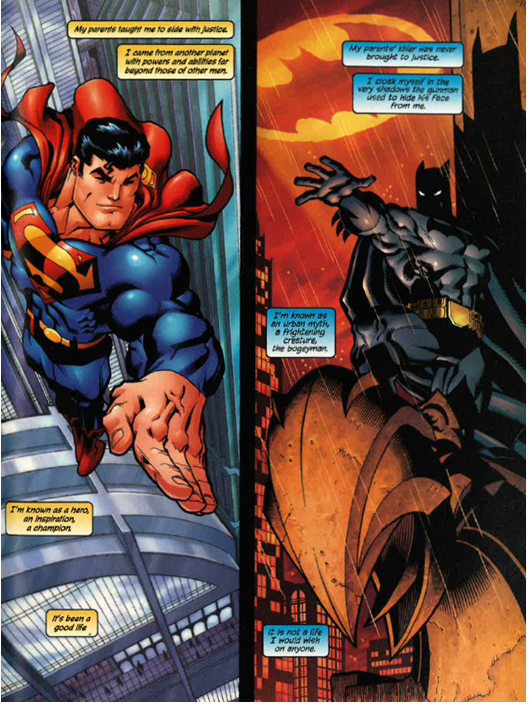
Jeph Loeb analyzes this superhero relationship with “World’s Finest” – also called “Public Enemies” thanks to an animated film adaptation – the first six-issue arc of Superman/Batman (2003), illustrated by Ed McGuinness. Loeb deftly intertwines internal monologues highlighting differences while explaining why the two highly respect each other. Readers see the differences from the beginning. Why would Superman give Batman any notice, and accordingly, why would Batman not scoff at Superman’s naivete when he declares, “It’s been a good life?” “World’s Finest” isn’t a first-meet story. Superman and Batman have gotten past their differences and their association is well-developed, so Loeb concentrates on telling us how that association works.
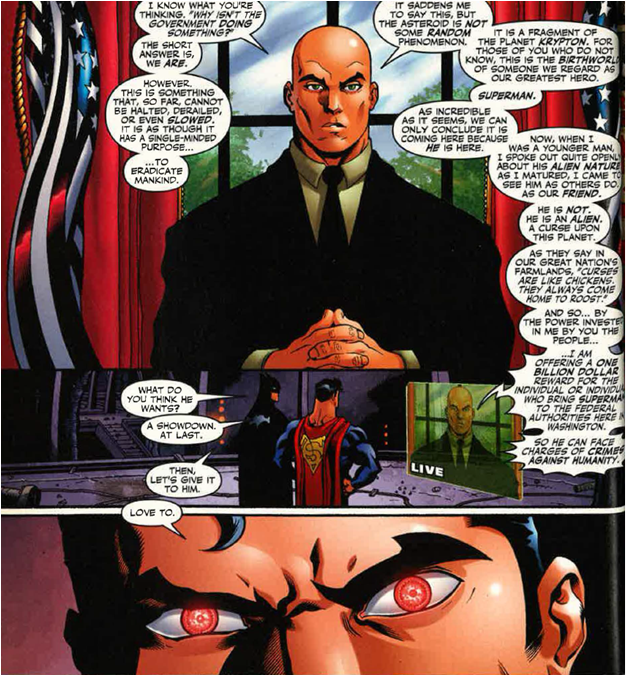
The story involves an enormous Kryptonite asteroid headed straight for Earth, and President Lex Luthor – yes, Lex Luthor is President of the United States, but that’s another paper altogether – exploiting opportunities for eliminating Superman once and for all. Luthor states outright via television that Superman is responsible and offers a $1,000,000,000 bounty for anyone who brings him to “justice.” Both heroes and villains respond, but where’s Batman in all this? As always, he’s right by Superman’s side. When Luthor makes his proclamation, Batman asks, “What do you think he wants?” Superman answers, “A showdown, at last.” Batman comes back, “Then let’s give it to him.” Superman agrees, “Love to.” Other heroes doubt Luthor but follow suit, pursuing what they see as the course of justice. Not Batman. Batman knows Superman and though he’s not named in the bounty, supports his friend completely. Batman is Superman’s ride-or-die. Friendship doesn’t get any deeper than that.
Superman and Batman go on the run, and villains attack en masse. Luthor forms a cadre of heroes including Captain Atom, Power Girl, Green Lantern: John Stewart, Black Lightning, Katana, Starfire, and Major Force. But, hey, we’re talking about the World’s Finest. What’s more, we’re talking about a World’s Finest that’s had it with Luthor. This motivation, along with them being friends so engrained they communicate almost telepathically, keeps them going. Finally, Hawkman and Captain Marvel (later Shazam but still Captain Marvel here) attack the duo. Batman perceives how to shift the battle, referring to castling, a chess maneuver where the king and the rook change places. Batman utters, “S. Castling.” Superman, knowing that Batman loves chess, immediately understands that Batman wants them to switch partners, with Superman confronting Hawkman while Batman pairs with Captain Marvel. The ploy succeeds largely because Superman reads Batman so quickly, almost on a psychic level. Talk about a team-up. Talk about a friendship.

When Superman and Batman confront Luthor, Superman grabs Luthor by the throat and, noting how many years they’ve fought, reflects upon advice from his father: “My Dad taught me that when the fox is in the chicken house, you have to kill it . . . unless you plan on losing more chickens.” Superman’s eyes flash red hot. Luthor argues for his life: “If you take my life – you’ll be hunted – despised, so-called heroes demoralized everywhere.” Superman feels tempted: “Holding him like this – he’s so small, so frail. He would snap like it was nothing. “Do it then,” taunts Luthor, “Give me what I’ve always wanted – the end of you.”
Wait. Where’s Batman? Why isn’t he intervening? Wouldn’t a true friend talk the Man of Steel away from the cliff? Not necessarily. Batman tells Superman, “I will not stop you. There are ways we could make it look like an accident. Or better still — as if he’d disappeared without a trace.” While Superman internally reflects upon his father, Batman remembers how Commissioner Jim Gordon once talked him back from killing The Joker: “It was not that long ago I found myself in the same position with The Joker. Jim Gordon talked me down. But I am not Jim Gordon. And whatever evil The Joker has brought to Gotham City, it is dwarfed by what Luthor does to this entire planet. Worse . . . what he does to Clark.”
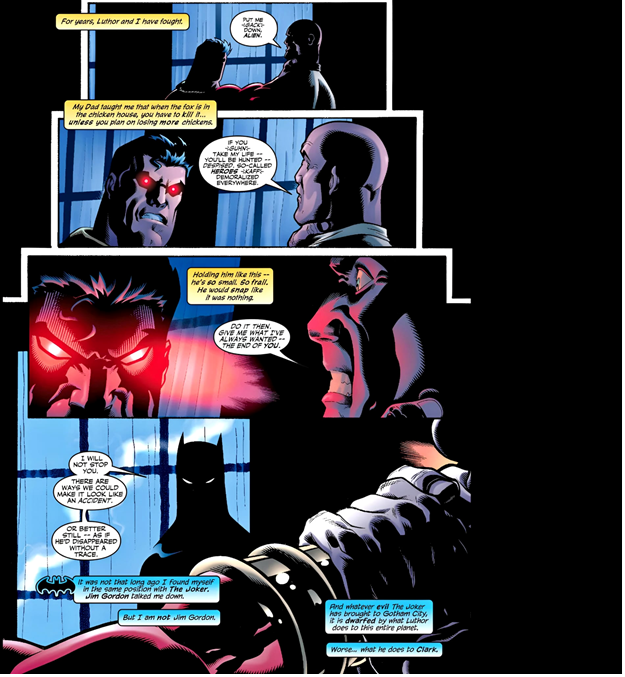
What makes Superman super? Flight? Strength? Heat vision? Sure, but more importantly it’s how he inspires others toward greatness, toward selfless actions benefiting others. Superman represents the greater good. He maintains these virtues despite powers that would corrupt most of us. And yet Superman is human, tempted toward base instincts, like ending Luthor’s life. Batman not so much. Batman admires Superman for what he represents, and for how he inspires him and others, but he’d rather see Luthor dead than watch his friend’s continual torment, undergoing that painful temptation — what Luthor does to Clark. Batman, a true friend, can’t stand his friend’s suffering.
Superman relents, however, tossing Luthor away. The incident drives the humiliated Luthor wild and his actions eventually lead to his removal from office. Superman and Batman are exonerated. But what about that Kryptonite asteroid? Superman and Batman approach Hiro Okamura, the teen genius Toyman, who builds a gigantic Composite Superman-Batman robot that reduces the asteroid to smaller, non-planet-threatening chunks. In the comic story, Captain Atom, after experiencing a come-to-Jesus moment about having supported Luthor, sacrifices himself by piloting the rocket into the asteroid. Events play out differently in the animated feature based on the comic, where Batman pilots the rocket instead of Captain Atom. Superman saves him, emphasizing the World’s Finest friendship theme.
May we all encounter such friends, who accept our foibles while supporting us through travails. Superman could not have survived without Batman’s assistance and interventions. His comments about making Luthor’s death look like an accident or disappearance shake Superman out of his temptation. Whether Batman meant this on top of what I discussed above is debatable, but Batman’s methods rarely are that simple. Regardless, only a true friend’s words could have penetrated that emotional storm, and surely Superman has done the same for Batman elsewhere. They are the World’s Finest, after all.
 I WILL FIND THE RIGHT WORDS