
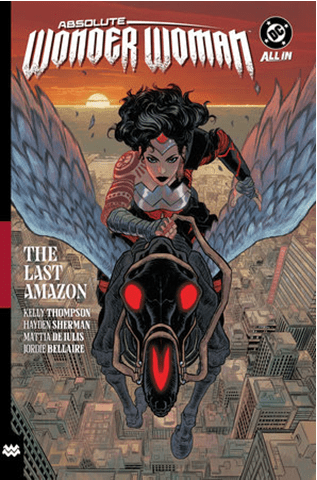
Once again, DC Comics is venturing into alternate universes with multiple titles. Imagine a reality created by Darkseid, one that sprang from his death, infused with his essence, through which he might revive himself. This isn’t Earth 3, the home of the outrightly villainous Crime Syndicate, nor is it the world of Justice League: Gods and Monsters, which features morally ambiguous analogs of Superman, Batman, and Wonder Woman. Superman, Batman, and Wonder Woman exist on Absolute Earth, Darkseid’s creation, but through a slightly cracked lens because, you know, Darkseid. The heroes still fight for good, but on an intensely turbulent Earth.
The Absolute Universe first appeared in the DC All-In Special (2024). The first title, Absolute Batman, has garnered praise, as have Absolute Superman, Absolute Martian Manhunter (arguably the strangest of the lot, but what else would you expect from writer Al Ewing?), and especially Absolute Wonder Woman, winner of the 2025 Eisner Award for Best New Series and a finalist for the 2026 Hugo Award for Best Graphic Story or Comic. No doubt, Absolute Wonder Woman is the standout, and no surprise, given writer Kelly Thompson’s overall career success.
Thompson enjoyed quite a showing at the 2024 Eisner Awards, netting five nominations, including Best Writer, Best New Series, Best Continuing Series, Best Limited Series, and Best Humor Publication. The next year, she won for Absolute Wonder Woman. Lest you think she’s an overnight phenomenon, allow me to tell you about Nancy Drew, Jem and the Holograms, Birds of Prey, Hawkeye, Uncanny X-Men, Mr. & Mrs. X, Rogue & Gambit, It’s Jeff!, West Coast Avengers, and Black Widow. Thompson is a superstar, and nowhere does she shine more brightly than with Absolute Wonder Woman.
Rather than a Diana raised among Amazons, Thompson gives readers a Wonder Woman raised in Hell by Circe the witch. Like in the mainstream reality, Diana rescues Steve Trevor, but here he doesn’t crash-land on Themyscira. He dies and goes to Hell. Diana saves him, returning him to the world, but she does so with dark magic that requires her to sacrifice her dominant arm, the arm of a great warrior. Later, Circe would help her replace it with a magical, awesomely tattooed prosthesis.
Lasso of Truth? No, this Diana wields the Nemesis Lasso, which Circe made from the last basilisk, infused with the blood of Prometheus, and blessed by Demeter, that causes those ensnared to burn in proportion to their sins. She rides a demonic Pegasus and swings the enormous Athena Blade. Blood magic and Hadean weapons? I did warn you that the Absolute Universe was somber-toned. And that’s just as well, given what it takes to defeat the Tetracide, with its Death of Fear aimed at Gateway City.
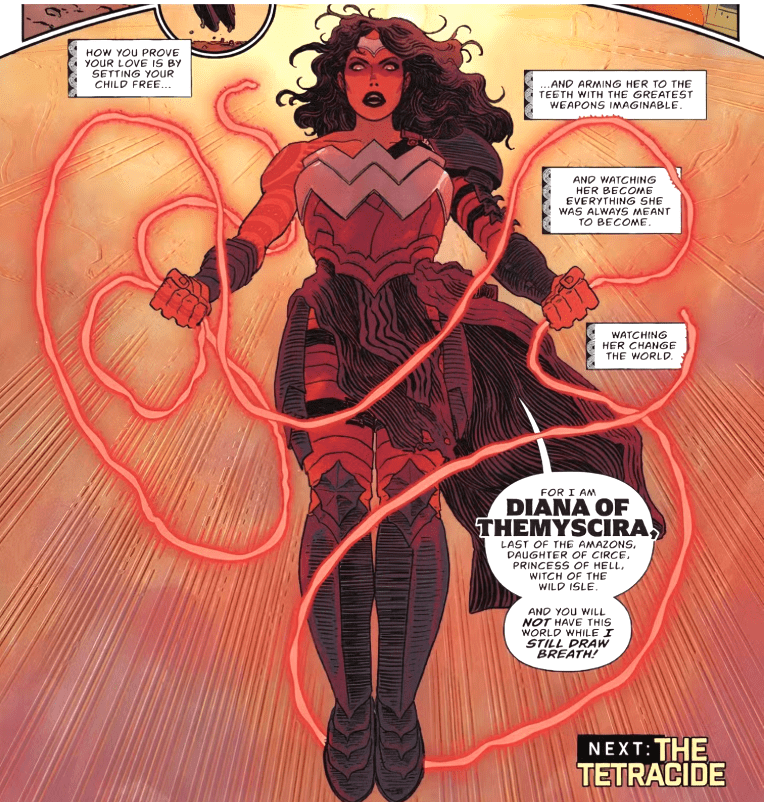
Thompson’s writing and Hayden Sherman’s art, with contributions from Mattia de Iulis, combine into a stunning mythopoesis, accentuating legendary Greek elements with an earthiness that George Perez, Greg Rucka, and Gail Simone would surely appreciate. Even William Moulton Marston might nod approvingly once he sees how Diana brings the main bad guy into submission. So far, the Hugo Best Graphic Story or Comic category has leaned toward the traditional-comic-hero shy. I’m ecstatic that Absolute Wonder Woman: The Last Amazon scored a place on the ballot. DC feels so confident about its Absolute Universe that the company has an animated Absolute Batman series in development. I hope DC follows suit with Absolute Wonder Woman. It’s the best among a great group of series. I predict certain comic historians will update their studies to include this version. Wonder Woman radiates optimism, wherever she resides and in whatever iteration, yes, the Absolute one too. Let’s hope that optimism pays off on Hugo Award Night.
 I WILL FIND THE RIGHT WORDS